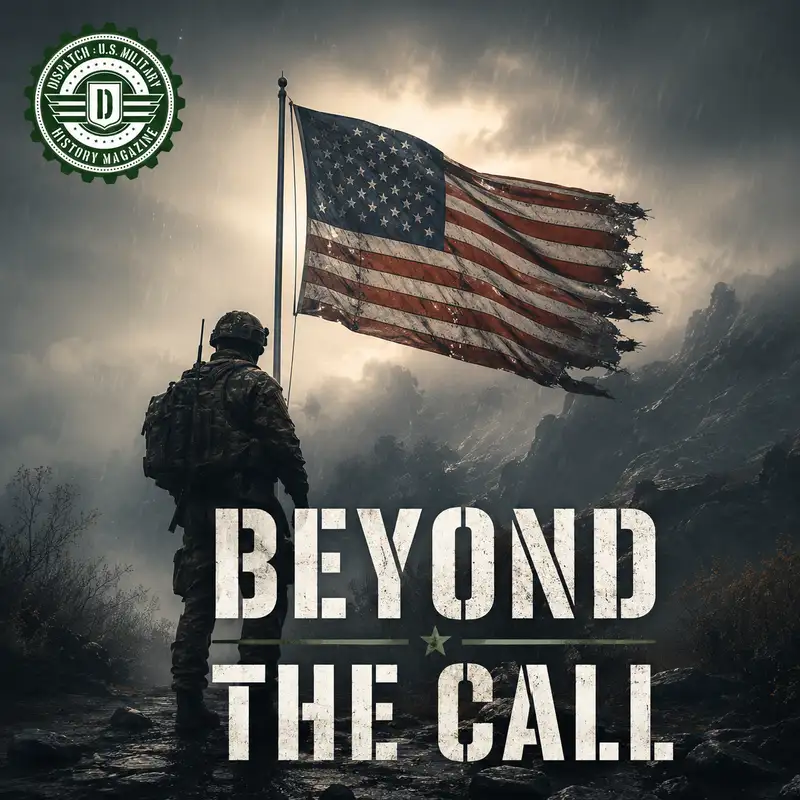
Beyond the Call: Private First Class Patrick L. Kessler at Ponte Rotto, Italy, 1944
Welcome to Beyond the Call, where history, leadership, and heroism come alive. Today’s story explores Private First Class Patrick L. Kessler at Ponte Rotto in nineteen forty four, a powerful account of courage and responsibility in combat. If you enjoy learning more about military history and extraordinary individuals, you can find more articles, podcasts, and resources at Trackpads dot com. On a spring day in Italy, a young infantryman from Ohio would make a choice that saved lives and turned the tide of a stalled attack. His actions would cost him everything, and they would also ensure that his name would never fade from the record of the war.
Before we continue, I want to mention the Medal of Honor book series that accompanies this work. These books tell the stories of America’s Medal of Honor recipients in a serious, readable, and historically grounded format, with each volume focused on a specific campaign, battle, or part of the war. They are available in color paperback, Kindle ebook, and matching audiobook editions. You can find them at Military Author dot me.
The scene is a field near the small Italian locality of Ponte Rotto, within the broader struggle of the Italian campaign as Allied forces fight their way inland from the Anzio beachhead toward Rome. The ground rolls gently but offers little real cover beyond shallow ditches and scattered farm buildings. Company K of the thirtieth Infantry Regiment moves forward across this ground when a German machine gun opens up, dropping several men in seconds and forcing the rest into a ditch barely deep enough to hide them. The company is pinned, the attack frozen in place, and the enemy gun dominates the only practical route forward. Beyond the Call is the Monday feature of Dispatch: U.S. Military History Magazine.
Pressed into the thin shelter of the ditch, Patrick Kessler can see the cost of staying where they are. Five comrades lie in the open, struck down in the first violent burst, and every attempt to move draws more fire that snaps just over the lip of the ditch. The company’s momentum has vanished, and with it the hard won progress of the larger attack. He understands that if the gun continues to fire unchecked, more men will die and the advance will likely fail. There is no time to wait for a detailed plan or additional orders. In that pressure, he decides that someone has to go after the gun, and that the someone will be him.
To understand how he reached that moment, it helps to step back from the Italian field and return to his beginnings in Middletown, Butler County, Ohio. Patrick Kessler was born there on March seventeenth, nineteen twenty two, in a community shaped by mills, factories, and the lean years of the Great Depression. He grew up in a time when families relied on steady work, shared burdens, and quiet resilience just to get by. By the time he approached adulthood, another war was already raging in Europe and Asia, and the United States was moving steadily toward involvement. Like many of his generation, he did not come from a long line of generals or admirals, but from ordinary citizens who carried heavy responsibilities.
When he entered the Army and put on the uniform of an infantryman, he stepped into a demanding profession that would test every lesson he had absorbed at home. Training taught him how to move under fire, how to read ground quickly, and how to keep his weapon working in rain and mud. It also taught him to trust the men on his left and right, and to accept that the safety of the group could depend on one person’s decision at a critical moment. Assigned to Company K of the thirtieth Infantry Regiment in the third Infantry Division, he joined a unit that had already endured hard fighting across the Mediterranean. In Italy, months of patrols, sudden bombardments, and bitter small unit actions had hardened the division but also taken a toll.
By May of nineteen forty four, Allied planners were ready to break out of the Anzio beachhead and punch through German defenses toward Rome. The third Infantry Division’s mission included driving against prepared positions that guarded roads, fields, and villages like Ponte Rotto. Company K received its orders to move forward across farmland cut by ditches and dotted with farmhouses that could hide enemy weapons. On paper, it was one more attack in a long campaign. On the ground, it would become the setting for Patrick Kessler’s final day. As the company left what little cover it had and pushed into the open, the first machine gun burst tore through its ranks.
The German gun was positioned to sweep the exposed approach, and its fire immediately struck down several soldiers, stopping the company cold. Those who could still move threw themselves into a shallow drainage ditch that offered only inches of protection from the rounds chewing up the soil. Officers and noncommissioned leaders struggled to get a clear picture in the chaos. Kessler did not wait. He quickly gathered three nearby soldiers and directed them to lay down covering fire on the enemy emplacement. Then he did the opposite of what instinct and self preservation would suggest. He left the relative safety of the ditch and began to crawl forward alone through the same deadly field.
The distance to the machine gun was roughly fifty yards, and for most of that space he had little more than low crops and uneven ground to hide him. He moved inch by inch, pressing himself into the earth while bullets cracked overhead and snapped into the soil around him. For a time the enemy crew did not notice the single figure sliding toward them. When they finally did, they swung the gun to engage him, turning its full firepower on one crawling rifleman. At that moment, instead of freezing, he exploded into a full rush, closing the last yards in a sudden sprint that carried him straight into the position.
At point blank range he shot the gunner and assistant gunner before they could cut him down. In the struggle that followed, he fought hand to hand with a third German soldier, overpowering him and taking him prisoner while a fourth managed to flee. Having silenced the weapon that had halted his company, Kessler began to move back toward friendly lines with his captive. The same open ground lay between him and the ditch, still under the threat of scattered enemy fire, but he had already shifted the balance by removing the primary gun that had trapped his comrades. For many soldiers, that act alone would have marked the height of courage in one day’s fighting.
As he moved with his prisoner, however, Kessler saw that Company K had run into even deeper trouble. A second strongpoint, even more heavily defended, had opened fire with machine guns and other weapons, inflicting more casualties on men who were trying to push the attack forward. He passed his prisoner to another soldier without delay and turned toward this new position. To reach it, he would have to cross more than one hundred yards of ground raked by shells and machine gun fire, and he knew that an antipersonnel minefield lay ahead. Even with that knowledge, he started forward again, crawling and edging his way through a zone that could have ended his advance at any step.
Artillery shells burst close enough to throw him from the ground and shower him with fragments, but still he pushed on until he reached a point within about fifty yards of the strongpoint. From there he engaged the enemy guns with his own fire, drawing their attention and taking some pressure off the pinned company behind him. When a shell exploded only a few feet away, the situation changed once more. Remaining in that shallow cover meant waiting to be bracketed and destroyed. Rising to his feet, he began a slow, deliberate walk toward the position, firing his Browning Automatic Rifle from the hip as he advanced. It was a deliberate act, not a blind charge, yet it exposed him completely.
Under that unexpected and relentless assault, the machine gun crews fell to his fire, and the remaining defenders broke. He reached the position, killed the gunners, and forced more than a dozen German soldiers to surrender. Even as he gathered these prisoners and started to lead them to the rear, new danger appeared. Two snipers, concealed at about one hundred yards, opened fire, and some of the captives tried to escape in the confusion. Kessler immediately dropped to the ground and fired along both flanks of the group, driving his prisoners back under control without cutting them down. Then he turned his weapon against the snipers and eliminated them in a brief, sharp exchange.
With the strongpoint broken, its guns silent, and the snipers removed, Company K could at last resume its advance. The path that had been a killing ground minutes before was now open ground they could cross. The official Medal of Honor citation that later honored these actions uses phrases like “conspicuous gallantry” and “intrepidity at the risk of life above and beyond the call of duty.” On the page, those words form a formal recognition of extraordinary valor. In the field near Ponte Rotto, they meant a young man repeatedly exposing himself to direct fire, mines, and shellbursts because he refused to accept that his company’s attack would end in that ditch.
The citation also notes that Kessler acted without orders when he first left cover to assault the machine gun. That detail matters because it highlights a kind of leadership that does not depend on rank. He saw a situation in which inaction meant defeat and greater loss of life, and he chose to take responsibility for changing it. When it describes him crawling through a mined area under artillery fire, then advancing in a slow walk toward the strongpoint, it captures not a single impulsive moment but a sustained series of choices to keep going despite every rational reason to stop. Each time he rose or moved forward, the odds tilted against his survival and toward the survival of others.
The impact of his actions went far beyond the number of enemy soldiers killed or captured. If the first machine gun had remained in place, Company K might have been forced to withdraw, leaving wounded men in the open and losing vital ground in the middle of a carefully timed breakout. If the second, larger strongpoint had held, it could have poured fire into the flank of any renewed attack, breaking it apart and delaying the broader advance toward Rome. By destroying both positions and securing prisoners under fire, Kessler helped ensure that his company could press on and that the larger effort at Anzio maintained its fragile momentum. Tactical success in campaigns like this often hinged on such small unit fights.
Behind these battlefield details stood a particular kind of character. Kessler was not a senior officer directing battalions but a private first class in a rifle company. His leadership came from action, from stepping into danger in ways that others could see and follow. He organized support before he moved, thought about how to protect the men behind him, and even in the chaos of managing prisoners under sniper fire, kept his focus on preserving life where he could. Modern terms like initiative, moral courage, and responsibility all apply to what he did that day. Yet at its core, his conduct reflected a simple conviction that the mission and the men beside him mattered more than his own safety.
Patrick L. Kessler did not survive to see the lasting results of the Italian campaign or the final defeat of Germany. He was killed in action on that day near Ponte Rotto, and the Medal of Honor that bears his name was awarded posthumously. For his family, his hometown of Middletown, and the comrades who had known him in training and in combat, the medal could not replace the person they had lost. What it did provide was a carefully recorded account of his deeds, ensuring that future generations would know more than just that he died in Italy. They would know how he lived his final hours and what he chose to do with them.
In the years since, his name has appeared on honor rolls, in histories of the third Infantry Division, and on memorials that remember those who fell in the Italian campaign. For people reading or hearing his story today, he can be seen not only as a figure in a formal citation but as a young man from Ohio who walked forward into fire so that his company could move again. His courage reminds listeners that history often turns on decisions made in seconds by individuals who may never have expected to be remembered. When we consider Patrick Kessler’s actions at Ponte Rotto, we are invited to remember not just a medal, but the quiet strength and resolve behind it.